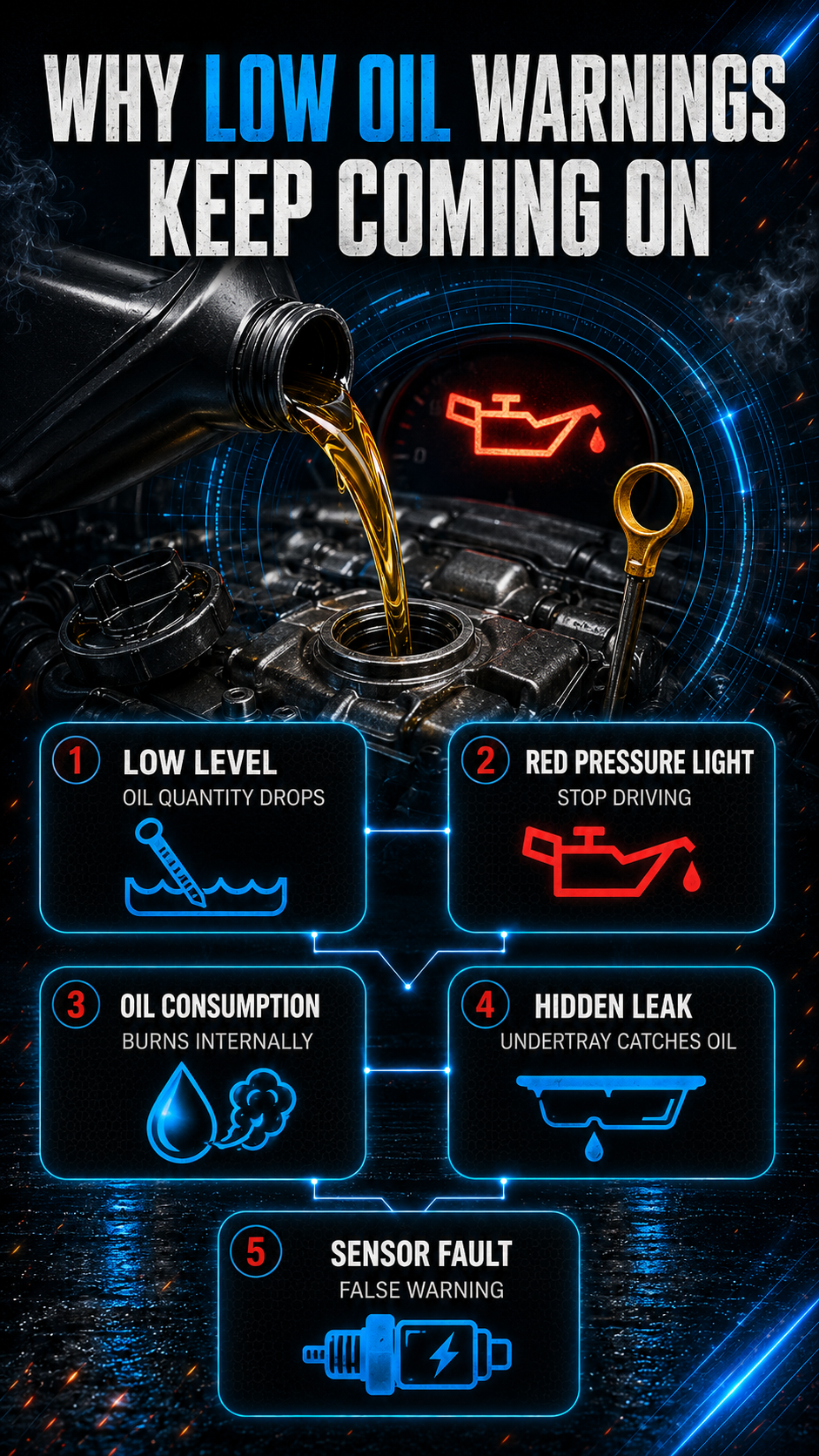
A low oil warning can return even when there is no puddle under the vehicle. The engine may be using oil internally, a leak may be collecting on an underbody panel, or the oil level sensor may be reporting an incorrect reading.
The first step is to identify whether the dashboard is showing a low oil level warning or a red oil pressure warning. These messages describe different conditions and require different responses.
First Determine What Kind of Idle Shake You Feel
Idle shakes can feel different depending on what is causing them. The technician needs to know when the vibration occurs, where it is felt, and whether engine speed changes too.
A Rough Engine and a Vibration Through the Cabin Are Different Clues
An uneven engine note, fluctuating tachometer, hesitation, exhaust popping, or loss of power can suggest a misfire or air-fuel problem. It may feel as though one cylinder is not contributing consistently.
By contrast, a steady cabin vibration with stable engine speed may point more toward a mount, exhaust contact point, or accessory load. In that case, the vehicle may be running correctly while transmitting more vibration than it should.
Drive, Neutral, Cold Start, and Air-Conditioning Loads Matter
A vibration that becomes stronger in Drive but improves in Neutral can place mounts and idle-control behavior higher on the inspection list. A cold-start roughness that clears after warming may involve fuel mixture, secondary air operation, ignition performance, or carbon deposits.
A small momentary change when the air-conditioning compressor engages can be normal. Repeated shuddering, stalling, belt noise, or a major RPM drop is not normal and should be checked.
Ignition Misfires Are a Common Cause of Rough Idle
An ignition misfire happens when a cylinder does not burn the air-fuel mixture consistently, which can make the engine run unevenly at idle. European vehicles may still drive with a light misfire, but the condition can worsen under load or damage emissions components.
Spark Plugs and Ignition Coils Can Fail in Different Ways
Spark plugs and ignition coils can both cause ignition problems, but each may fail in ways that produce different symptoms. Worn, fouled, incorrectly gapped, or oil-contaminated spark plugs can weaken the spark. An ignition coil may fail continuously, only when hot, or under certain loads. Testing the affected cylinder before replacing parts helps avoid unnecessary spark plug or coil replacement.
A misfire diagnosis for BMW, Mercedes-Benz, Audi, and other European vehicles may begin with a fault-memory review and cylinder misfire counters. Technicians may also compare coils or plugs and inspect the plug wells for oil or coolant. The test plan depends on the engine and the stored data.
A Flashing Check Engine Light Requires Prompt Attention
A steady check engine light means the engine computer has detected a fault, but the vehicle may still feel normal. A flashing light commonly warns of an active misfire severe enough to threaten the catalytic converter.
Reduce speed and load if the light begins flashing. If the vehicle is shaking heavily, losing power, smelling strongly of fuel, or making abnormal mechanical noise, pull over safely and arrange professional assistance.
Air Leaks and Fuel Problems Can Upset the Mixture
Air leaks or fuel-delivery problems can upset the air-fuel mixture and make the engine run lean or idle unevenly. The engine computer adjusts fuel delivery according to measured airflow and sensor feedback. Air entering where it should not, or fuel arriving at the wrong pressure or pattern, can create a lean or uneven idle.
Vacuum, PCV, Intake, and Airflow Sensor Faults
Cracked hoses, failed crankcase ventilation components, intake-manifold leaks, loose connections, or damaged seals can introduce unmetered air. Some European engines also develop PCV diaphragm or valve-cover faults that cause whistling, excessive crankcase vacuum, oil leaks, or rough idle.
A contaminated or inaccurate airflow sensor may also affect mixture control, but the sensor should be evaluated with live data before replacement. Smoke testing is often useful for locating small intake leaks that are difficult to see.
Injectors, Fuel Pressure, and Contaminated Fuel
A restricted or leaking injector can make one cylinder run differently from the others. Low fuel pressure, pressure-control faults, or a weak pump can affect several cylinders and may also cause hard starting or hesitation.
Contaminated fuel can also disrupt combustion or injector operation, depending on the type and extent of contamination. Fuel-trim readings, injector contribution tests, pressure measurements, and service history help separate injector problems from ignition faults or air leaks. Fuel additives are not a substitute for diagnosis when the vehicle is already shaking.
Engine Mounts Can Amplify Normal Engine Movement
Engine and transmission mounts secure the powertrain while limiting how much normal engine vibration reaches the cabin. Hydraulic or electronically controlled mounts on some European vehicles can soften, leak, collapse, or stop responding correctly over time.
Mount Problems May Not Trigger a Warning Light
A failed mount can create a strong vibration at idle without storing an engine fault code. The vibration may be most noticeable in the steering wheel, seat, floor, or dashboard while the engine speed remains steady.
Other signs include excess engine movement, a thump during shifting, or vibration that changes between Drive and Neutral. Exhaust contact with the body can also transmit vibration into the cabin. Mount condition should be inspected before assuming the engine itself is running poorly.
Accessory Loads and Exhaust Contact Can Feel Similar
A binding accessory pulley, failing belt tensioner, air-conditioning compressor issue, or exhaust component touching the body can add vibration at idle. These problems can mimic a mount or combustion issue, especially when the vibration changes as accessories turn on or off.
Carbon Buildup and Mechanical Problems Need Targeted Testing
Intake-valve deposits or internal engine faults can both cause rough running, so testing is needed to determine which problem is responsible. Some direct-injection European engines develop deposits on the intake valves because fuel does not wash across the valve surfaces. Heavy deposits can disturb airflow and contribute to cold-start misfires, uneven idle, or reduced performance.
Carbon Cleaning Should Follow Inspection and Data Review
Carbon buildup should be confirmed through inspection and diagnostic data rather than assumed from mileage alone. Borescope inspection, misfire patterns, fuel trims, and engine-specific history can help determine whether deposits are significant enough to affect operation.
If deposits are confirmed, the appropriate cleaning method depends on the engine design. Routine chemical additives in the fuel tank generally do not clean intake valves on a direct-injection-only engine.
Compression, Timing, and Internal Engine Concerns
Low compression from valve, ring, cylinder, or head-gasket problems can cause a persistent cylinder imbalance. Camshaft timing faults, variable-valve-timing problems, or timing-chain wear may also affect idle quality and set related fault codes.
Compression and leak-down testing may be needed when ignition, fuel, and air tests do not explain the symptom. Technicians may also review camshaft correlation data, oil condition, and other mechanical findings.
How European Engine Diagnostics Find the Actual Cause
Professional European engine diagnostics in Boca Raton, FL, combine the driver’s observations with scan data to determine where further testing should focus. Fault codes identify the system that detected a problem, but they do not automatically identify the failed part.
A Complete Test Plan Goes Beyond Reading Codes
Depending on the symptom, testing may include live misfire data, fuel trims, oxygen-sensor response, intake smoke testing, fuel-pressure checks, ignition testing, compression testing, mount inspection, and a road test. Freeze-frame data can show engine temperature, load, speed, and other conditions present when a fault was recorded.
Clearing codes or disconnecting the battery before the appointment can erase useful information. Leave the warning light and stored data intact unless a technician gives different instructions.
The Repair Should Match the Confirmed Fault
The right repair depends on what testing confirms, and a rough idle does not always require major engine work. The solution may involve a hose, plug, coil, mount, software adaptation, injector, sensor, or mechanical component. Confirming the cause helps avoid replacing unrelated parts.
When Is It Safe to Drive a Car That Shakes at Idle?
Driving may be reasonable for a short distance if the vibration is mild, the vehicle runs normally, and no warning signs appear. A persistent shake should still be inspected soon. Continued driving can allow a misfire, fuel problem, or damaged mount to affect other components.
Stop Driving When Serious Warning Signs Appear
Pull over safely and arrange assistance if the check engine light is flashing, the vehicle has severe power loss, or the engine is overheating. Stop driving if an oil-pressure warning appears, strong raw-fuel odors are present, smoke is visible, or loud knocking develops. These symptoms may indicate a condition that can damage the engine, catalytic converter, or other systems.
Document the Conditions Before the Appointment
Note whether the shake occurs cold or warm, in Park or Drive, with the air conditioner on or off, and at a specific engine speed. Record any warning messages, recent repairs, fueling events, hard starts, stalling, or loss of power. These details can shorten the diagnostic path.
Schedule Check Engine Light and Rough Idle Repair in Boca Raton, FL
A European car that shakes at idle needs testing based on its engine design, fault history, and current symptoms. Shores Automotive provides dealer-level diagnostic software, live-data analysis, and engine repair services for European and exotic vehicles in Boca Raton.
The shop is located at 2544 NW 2nd Avenue, Boca Raton, FL 33431. Qualifying repairs include a 3-year/36,000-mile nationwide warranty. Contact the team to schedule a rough-idle inspection and receive a clear explanation of the findings before repairs begin.
Frequently Asked Questions
Can the air conditioner make my European car shake at idle?
Yes, the air conditioner can cause a slight, brief vibration or change in engine speed when the compressor engages. Strong shuddering, repeated stalling, belt noise, or a large RPM drop may indicate an idle-control, mount, belt-drive, compressor, or engine-performance problem.
Can bad engine mounts cause vibration without a check engine light?
Yes, engine and transmission mounts are mechanical vibration-control components, so a failed mount may not trigger a warning light. A stable tachometer with strong cabin vibration, especially in Drive, can make mount inspection an important part of the diagnosis.
Can low fuel pressure cause a rough idle?
Low or unstable fuel pressure can cause rough idle, hard starting, hesitation, or loss of power. A technician should measure the appropriate low- and high-pressure systems because symptoms can overlap with ignition, injector, air-leak, and sensor problems.
Can I keep driving if the check engine light is steady?
A steady check engine light does not always require an immediate stop, but the vehicle should be diagnosed promptly. Stop driving if the light begins flashing or the car develops severe shaking, overheating, strong fuel odors, smoke, or major power loss.
How often should I schedule engine diagnostics?
Engine diagnostics do not normally need a fixed annual schedule when the vehicle has no symptoms or warning lights. Follow the manufacturer’s maintenance plan and watch for changes in vehicle performance. Schedule diagnostic testing if a warning light appears or you notice rough idle, hard starting, stalling, power loss, unusual noise, or fuel-economy changes.
Address a Rough Idle Before It Causes More Problems
A European car that shakes at idle may have a minor mount or hose problem, an ignition misfire, a fuel or airflow fault, carbon deposits, or an internal engine concern. The symptom alone cannot identify the failed part.
Schedule European diagnostics with Shores Automotive in Boca Raton, FL, to identify the cause and determine which repairs deserve attention.
A European car may shake at idle when the engine is not firing evenly or the air-fuel mixture is incorrect. Worn mounts can also allow normal engine movement to reach the cabin. Common causes include ignition misfires, vacuum or PCV leaks, fuel-delivery problems, carbon buildup, and damaged engine or transmission mounts. The pattern matters. A shake that appears only in Drive, worsens with the air conditioner on, or triggers a check engine light can point to different causes. If it disappears as engine speed increases, that change also gives the technician a useful clue. A proper engine diagnosis should identify the cause before parts are replaced.
Key Takeaways
- A rough idle can come from a combustion problem or from worn mounts that transmit vibration into the cabin.
- Spark plugs, ignition coils, vacuum leaks, PCV faults, injectors, and fuel-pressure problems are common diagnostic starting points.
- A flashing check engine light may indicate an active misfire that can damage the catalytic converter.
- Direct-injection engines may develop intake-valve carbon buildup, but testing is needed before cleaning is recommended.
- European engine diagnostics should combine fault codes, live data, inspections, and targeted tests rather than relying on a basic code scan alone.
Get started today
Mon – Fri | 7:30am – 4:00pm
Sat – Sun | Closed