
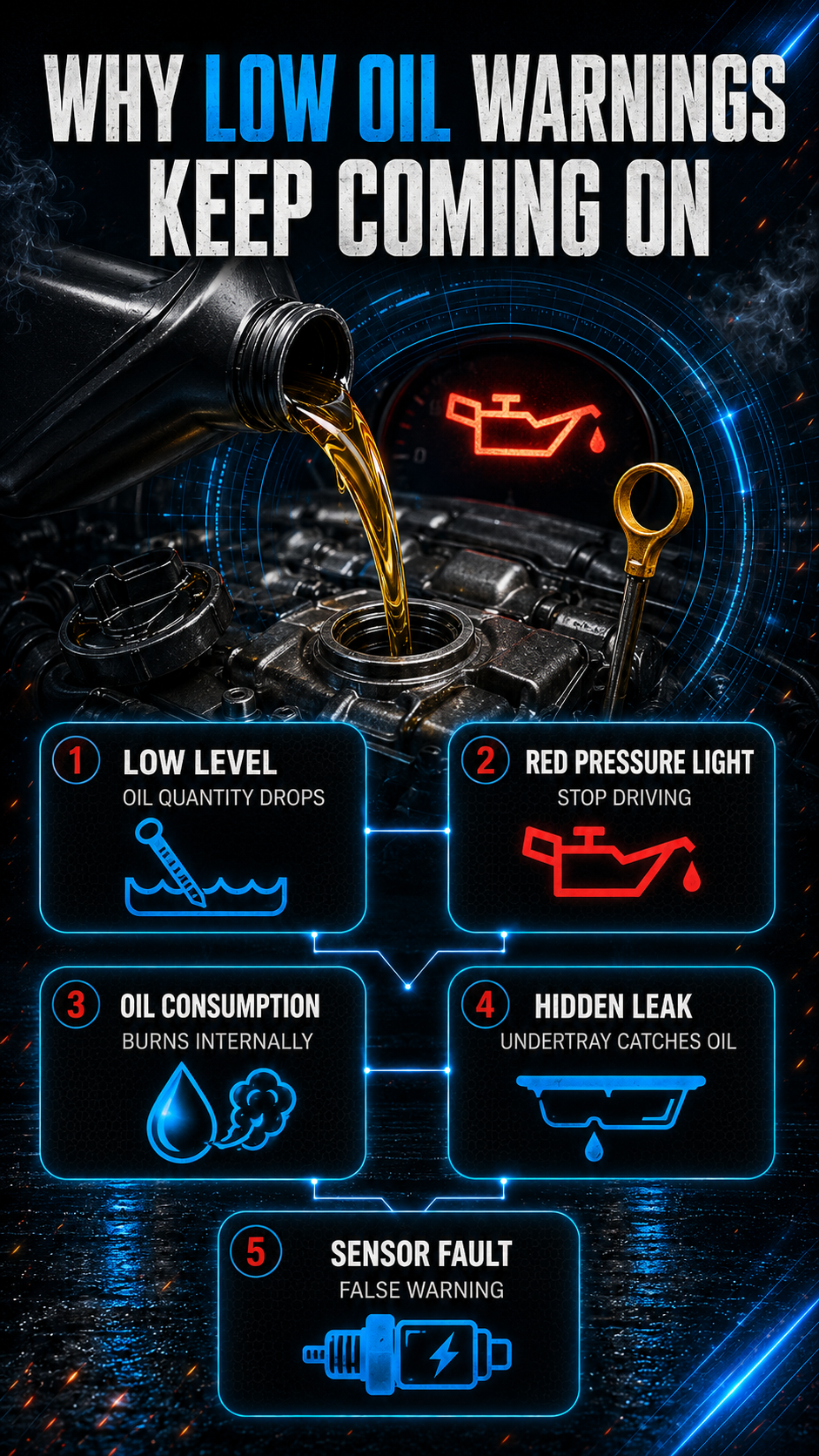
A low oil warning can return even when there is no puddle under the vehicle. The engine may be using oil internally, a leak may be collecting on an underbody panel, or the oil level sensor may be reporting an incorrect reading.
The first step is to identify whether the dashboard is showing a low oil level warning or a red oil pressure warning. These messages describe different conditions and require different responses.
Identify What the Rough Ride Feels Like
The way the vehicle reacts over a bump provides useful diagnostic clues. A car that hits sharply, bounces several times, rattles, or vibrates at highway speed may have different faults.
Harsh Impact, Repeated Bounce, and Vibration Are Different Symptoms
A sharp impact over a small seam may come from high tire pressure, stiff or damaged tires, hardened bushings, or a binding damper. Other possible causes include a deteriorated bump stop or a suspension system stuck in a firm setting. Repeated bouncing after the bump more often points toward weak damping or poor body control.
A steering-wheel or seat vibration that increases with road speed is more likely to involve tire balance, tire damage, wheel runout, or a bent wheel. A clunk or knock over one-wheel bumps may direct the inspection toward mounts, links, bushings, ball joints, or loose hardware.
Some European Cars Are Firm by Design, but Changes Still Matter
Performance suspension, large wheels, low-profile tires, and run-flat construction can produce a firmer ride than a comfort-oriented vehicle. That normal firmness should remain consistent.
A ride that becomes harsher, noisier, lower on one side, or less stable deserves inspection. Compare the current behavior with how the vehicle normally drives rather than judging it against a different model.
Shocks, Struts, and Dampers Can Affect Ride Control
Dampers control spring movement and keep the tires in contact with the road. They can affect comfort, steering response, braking stability, and tire wear when they leak, weaken, bind, or stop responding correctly.
Worn Dampers Do Not Always Create the Same Symptom
Weak shocks or struts commonly allow extra bouncing, floating, nose dive, or body movement. A very sharp response over small bumps can also come from a damper that is internally binding, an incorrect replacement part, or damaged upper mounts. Other possible causes include collapsed bump stops or an adaptive damper that remains in a firm mode.
Visible fluid on a damper may support the diagnosis, but appearance alone is not enough. A road test and comparison of suspension movement at all four corners help determine whether the damper is controlling the vehicle correctly.
Mounts and Bump Stops Can Add Noise and Harshness
Strut mounts isolate vibration and allow the suspension to move without sending every impact into the body. Worn bearings, separated rubber, loose fasteners, or damaged mounts can create knocking, binding, or a rough feel.
Bump stops limit suspension travel. A missing, deteriorated, or repeatedly contacted bump stop can make moderate road inputs feel like hard impacts. This is especially true if the vehicle sits too low or carries an incorrect spring.
Control Arms, Bushings, and Ball Joints May Transmit Road Impact
Control arms locate the wheel, while bushings and ball joints allow controlled movement. Rubber can crack, harden, separate, or shift inside its sleeve as it ages.
Hardened or Torn Bushings Can Reduce Isolation
A bushing that no longer flexes correctly can transmit more road impact into the cabin. A torn bushing may also let the wheel move farther than intended during braking, acceleration, or cornering.
Possible symptoms include clunks, steering wander, brake pull, uneven tire wear, a changing alignment, or a thump when the vehicle crosses a driveway entrance. Because several bushings may be loaded at the same time, the technician should inspect the complete axle rather than assume one visible crack is the only concern.
Loose Joints Can Affect Both Comfort and Control
Ball joints, tie-rod ends, sway-bar links, and related connections can create noise and unwanted wheel movement when worn. Excessive play may affect steering accuracy and tire contact, while a seized joint can prevent the suspension from moving freely.
Any looseness in a safety-related steering or suspension joint should be addressed promptly. An alignment cannot correct mechanical play or a binding component.
Tires and Wheels Can Make a European Car Feel Rough
Ride quality can change significantly when tire sidewalls do not absorb road impacts properly or wheel condition prevents the vehicle from rolling smoothly. Pressure, construction, age, load rating, wear, and wheel condition all affect ride quality.
Check Pressure Against the Vehicle Placard
Use the pressure listed on the vehicle placard or in the owner’s manual when the tires are cold. The maximum pressure molded into the tire sidewall is not the normal inflation target for the vehicle.
Excess pressure can make the ride harsher and reduce the tire’s ability to absorb small road irregularities. Low pressure can cause sluggish handling, heat buildup, sidewall damage, and uneven wear. Tire pressure may also change with temperature, so recheck it after seasonal or weather changes.
Low-Profile, Run-Flat, Worn, or Damaged Tires Need Inspection
Low-profile and run-flat tires usually have stiffer sidewalls than conventional touring tires. A tire with the wrong size, load rating, speed rating, or construction can change ride comfort even when it fits the wheel.
Cupping, flat spots, internal belt damage, sidewall bulges, hardened rubber, or uneven tread can create impact harshness and vibration. Replace any tire with structural damage. Tire selection should follow the manufacturer’s requirements and the way the vehicle is used.
Bent Wheels and Balance Problems Produce Different Clues
A bent or cracked wheel may cause vibration, air loss, or an uneven tire bead. Wheel balance problems usually become more noticeable within a particular speed range rather than only when crossing small bumps.
A wheel and tire assembly should be checked for balance, runout, damage, and correct mounting. Road-force measurement may help identify a tire or wheel variation that a basic balance does not fully explain.
Springs, Ride Height, and Alignment Also Need Attention
Springs support vehicle weight and establish ride height. A broken, sagging, incorrect, or poorly seated spring can reduce suspension travel and change wheel alignment.
A Broken or Sagging Spring Can Put the Vehicle on the Bump Stops
Look for one corner sitting lower, uneven wheel-arch gaps, scraping, metal contact, or a sudden change after a pothole. A broken spring may be difficult to see when the break is near the upper or lower seat.
Do not continue driving if a broken spring can contact the tire, brake hose, or other components. The spring, seat, damper, and nearby parts should be inspected together because one failure can damage another component.
Alignment Can Reveal a Problem but May Not Fix Harshness
Incorrect alignment can cause pulling, steering-wheel position changes, instability, and uneven tire wear. It does not usually create a sharp ride by itself.
Alignment measurements can help reveal bent, shifted, or worn parts. Mechanical faults and ride-height problems should be repaired before the final alignment is completed.
Electronic and Air Suspension Faults Require Additional Testing
Finding the source of a ride-quality problem may require specialized testing when no obvious fluid or air leak is present. Many European vehicles use electronic dampers, air springs, ride-height sensors, selectable drive modes, or active roll-control systems.
Adaptive Dampers May Stay in the Wrong Setting
A failed accelerometer, ride-height sensor, damper valve, wiring circuit, control module, or calibration can affect how the suspension responds. The vehicle may remain unusually firm, display a chassis message, or disable adjustable modes.
A full vehicle scan should be combined with live-data review and mechanical checks. Replacing a damper without confirming the electrical command, power supply, wiring, and calibration may leave the original concern unchanged.
Air Suspension Problems Can Change Height and Travel
An air leak often causes one corner or axle to settle after parking, but valve-block, compressor, sensor, or control faults can also produce incorrect height. Too little suspension travel can make bumps feel severe, while an overworked compressor may eventually fail.
Measure ride height on level ground and compare it with the manufacturer’s procedure. Air-suspension service may require leak testing, pressure checks, scan-tool commands, and calibration after parts are replaced.
When a Rough Ride Needs Prompt Inspection
A gradual change in comfort should be scheduled for inspection, but some symptoms indicate a more urgent safety concern.
Stop Driving for Tire, Wheel, Spring, or Steering Hazards
- Do not drive on a tire with a sidewall bulge, exposed cords, rapid air loss, or visible internal damage.
- Arrange towing for a cracked wheel, a spring that can contact the tire, or a vehicle sitting severely low on one corner.
- Stop if steering becomes loose, binds, changes suddenly, or the vehicle is difficult to control.
- Do not ignore strong metal-to-metal impacts, severe vibration, or a chassis warning combined with reduced stability.
- Slow down and avoid potholes, heavy loads, and high speeds until a mild but unexplained rough ride can be inspected.
Document When the Symptom Happens
Note whether the concern is worse when cold, after parking, in one drive mode, during braking, with passengers, or at a certain speed. Record recent tire replacement, wheel impact, suspension work, alignment service, or warning messages.
Photos of the vehicle’s ride height and dashboard messages can help with intermittent concerns. Do not clear chassis codes or disconnect the battery before the appointment unless the owner’s manual directs you to do so for safety.
What a European Steering and Suspension Inspection Should Include
At Shores Automotive, the inspection begins by reproducing the symptom, then comparing tire, mechanical, and electronic findings before recommending parts.
The Diagnostic Process Should Match the Symptom
- Confirm tire size, construction, age, load rating, pressure, tread condition, balance, and wheel runout.
- Road-test the vehicle on a route that reproduces the impact, bounce, noise, or vibration when it is safe to do so.
- Inspect shocks, struts, mounts, bump stops, springs, control arms, bushings, ball joints, tie rods, links, and fasteners.
- Measure ride height and alignment angles after mechanical condition is confirmed.
- Scan chassis, suspension, steering, and body modules when the vehicle has adaptive or air suspension.
- Review live data, sensor plausibility, drive-mode commands, calibration status, and stored fault histories.
Repairs Should Be Based on Findings, Not a Mileage Guess
Shocks and struts do not have one replacement interval that applies to every European vehicle. Vehicle design, road conditions, tire setup, load, mileage, and component condition all affect service life.
Replace parts when testing confirms wear, damage, leakage, binding, play, an electronic fault, or performance outside the manufacturer’s limits. Related components may need service in pairs or as an axle set when the repair procedure requires matched operation.
Schedule European Suspension Repair in Boca Raton, FL
Shores Automotive provides suspension, steering, and wheel services for European and exotic vehicles in Boca Raton, FL. The shop addresses ride-quality concerns, alignment, tire wear, steering feel, wheel vibration, and handling problems using dealer-level software and OEM or approved OE-equivalent parts.
Shores Automotive services BMW, Mercedes-Benz, Porsche, Audi, Land Rover, Jaguar, MINI, Maserati, Bentley, Rolls-Royce, Alfa Romeo, and Aston Martin vehicles. Qualifying repairs carry a 3-year warranty. The shop is located at 2544 NW 2nd Ave in Boca Raton, FL.
Schedule a European steering and suspension inspection or call (561) 391-0260 when a rough ride, clunk, vibration, or uneven height changes the way your vehicle drives. Tire wear or a chassis warning that affects ride or handling can also signal the need for an inspection.Frequently Asked Questions
How often should shocks and struts be replaced?
There is no universal replacement mileage for every vehicle. Shocks and struts should be inspected according to the manufacturer’s maintenance guidance and whenever the vehicle bounces, leaks, handles poorly, wears tires unevenly, or develops suspension noise.
Can tire pressure make a European car ride rough?
Yes, pressure above the vehicle placard specification can make small road imperfections feel sharper. Check cold pressure in all four tires and confirm that the tire size, type, and load rating match the vehicle requirements.
Why did the ride become rough after new tires were installed?
The new tires may have a stiffer construction, different sidewall height, higher load rating, incorrect pressure, balance problem, or mounting issue. Confirm the specifications and inspect the wheels before assuming that the suspension failed at the same time.
Will a wheel alignment fix a harsh ride?
A wheel alignment usually will not fix a harsh ride by itself. It can correct wheel angles after worn or damaged parts are repaired. However, it cannot fix a damaged tire, bent wheel, weak damper, broken spring, failed bushing, or electronic suspension fault.
Can I keep driving if the car only feels slightly rough?
Even a mild, unexplained change in ride quality should be assessed promptly. If you are unsure whether the vehicle is safe to drive, contact a qualified repair facility and arrange towing when recommended.
Conclusion
A European car that rides rough over small bumps may have a tire, wheel, damper, mount, bushing, spring, alignment, air-suspension, or electronic-control problem. The exact symptom and the conditions that produce it help narrow the cause.
Check tire pressure and visible damage first, then schedule European suspension repair in Boca Raton, FL, when the ride changes, noise develops, or the vehicle no longer feels stable. A complete inspection can identify the cause before unnecessary parts are replaced.
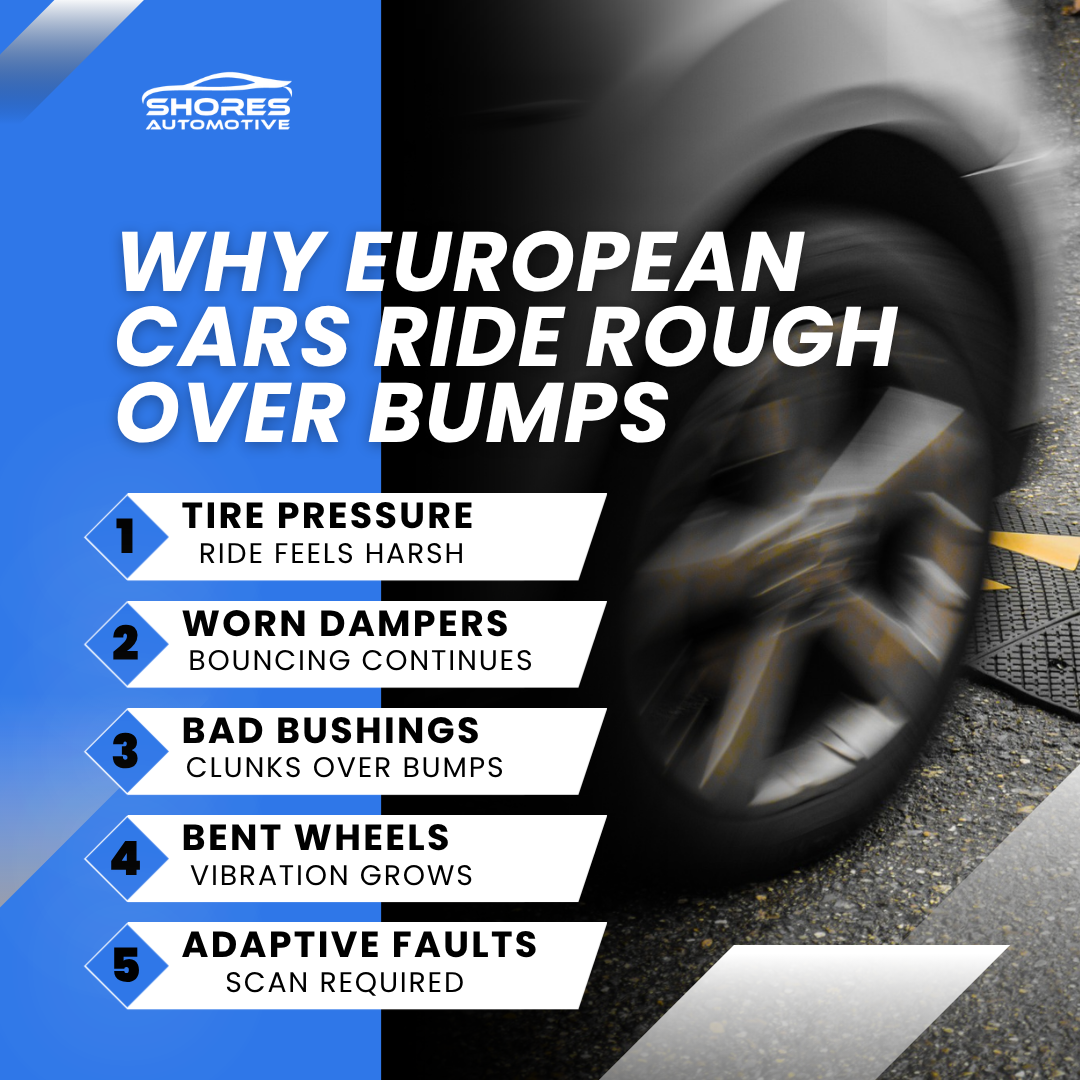
A European car may feel rough over small bumps when the tires, dampers, or bushings are no longer working as intended. The same can happen when the springs, mounts, wheels, or electronic suspension controls are not functioning properly. The cause is not always a failed shock or strut. Overinflated tires, hardened rubber components, damaged wheels, broken springs, or an adaptive suspension fault can create a similar complaint.
Pay attention to whether the vehicle feels harsh once, continues bouncing, vibrates at speed, makes noise, or sits lower on one corner. Those details help separate a tire or wheel problem from mechanical suspension wear or an electronic fault.
Key Takeaways
- A harsh impact, repeated bouncing, vibration, and clunking point toward different possible causes.
- Worn dampers often reduce body control, while binding components, damaged mounts, or incorrect tire pressure can make small bumps feel unusually sharp.
- Low-profile and run-flat tires naturally transmit more road texture, but a sudden change in ride quality still needs inspection.
- Control-arm bushings, ball joints, springs, bump stops, and strut mounts should be checked before individual parts are replaced.
- Adaptive and air suspension systems may require a full vehicle scan, ride-height checks, and calibration in addition to a mechanical inspection.
Get started today
Mon – Fri | 7:30am – 4:00pm
Sat – Sun | Closed