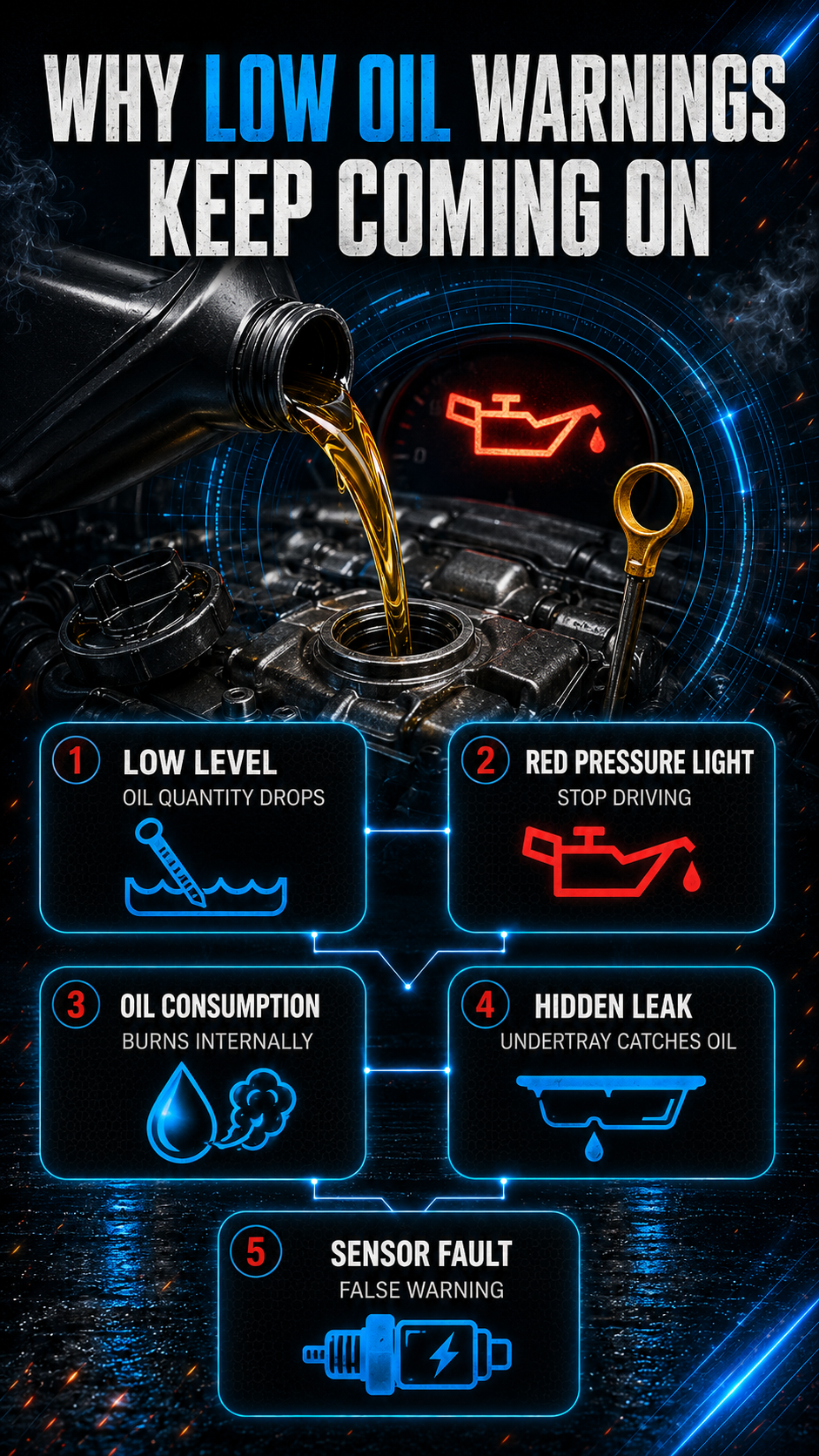
A low oil warning can return even when there is no puddle under the vehicle. The engine may be using oil internally, a leak may be collecting on an underbody panel, or the oil level sensor may be reporting an incorrect reading.
The first step is to identify whether the dashboard is showing a low oil level warning or a red oil pressure warning. These messages describe different conditions and require different responses.
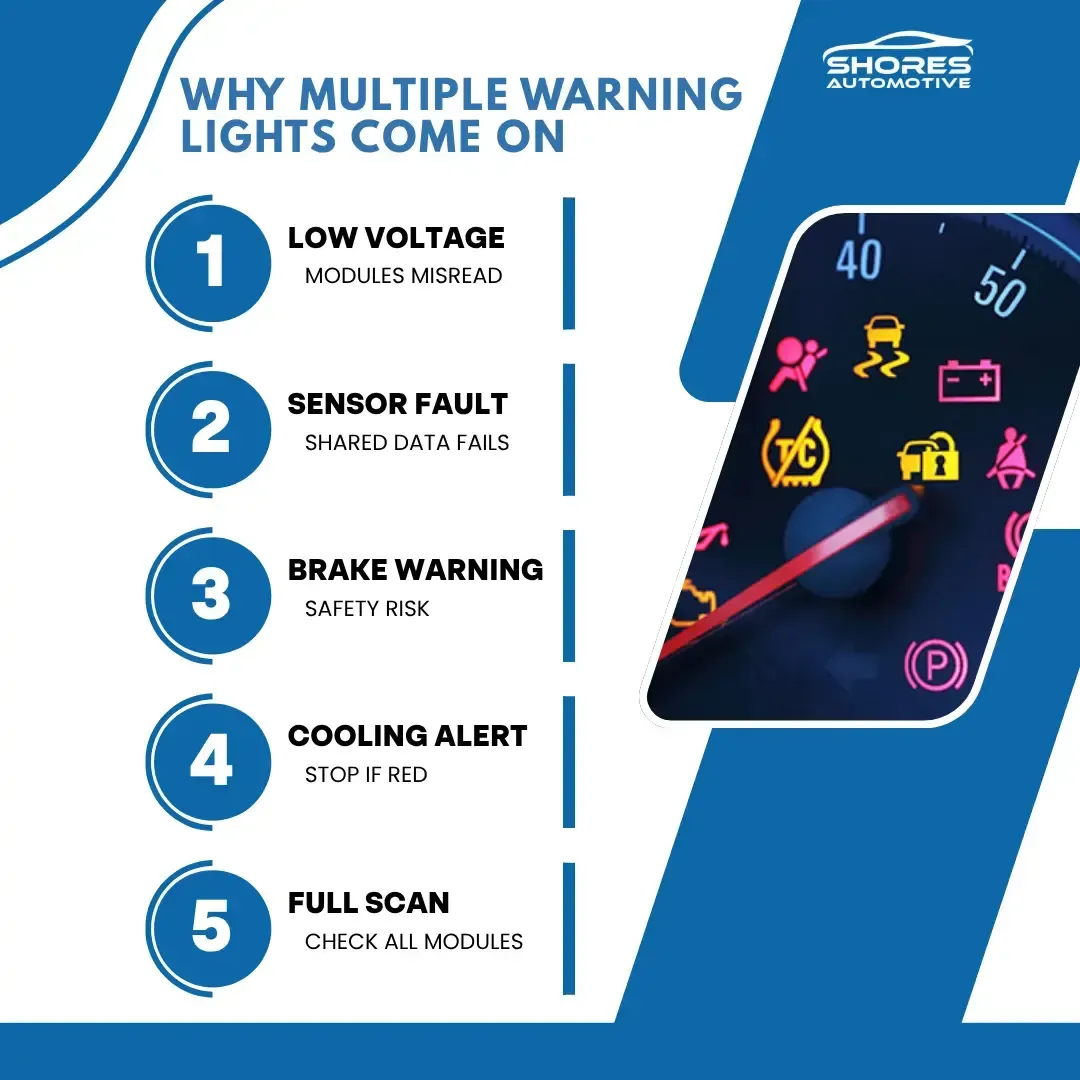
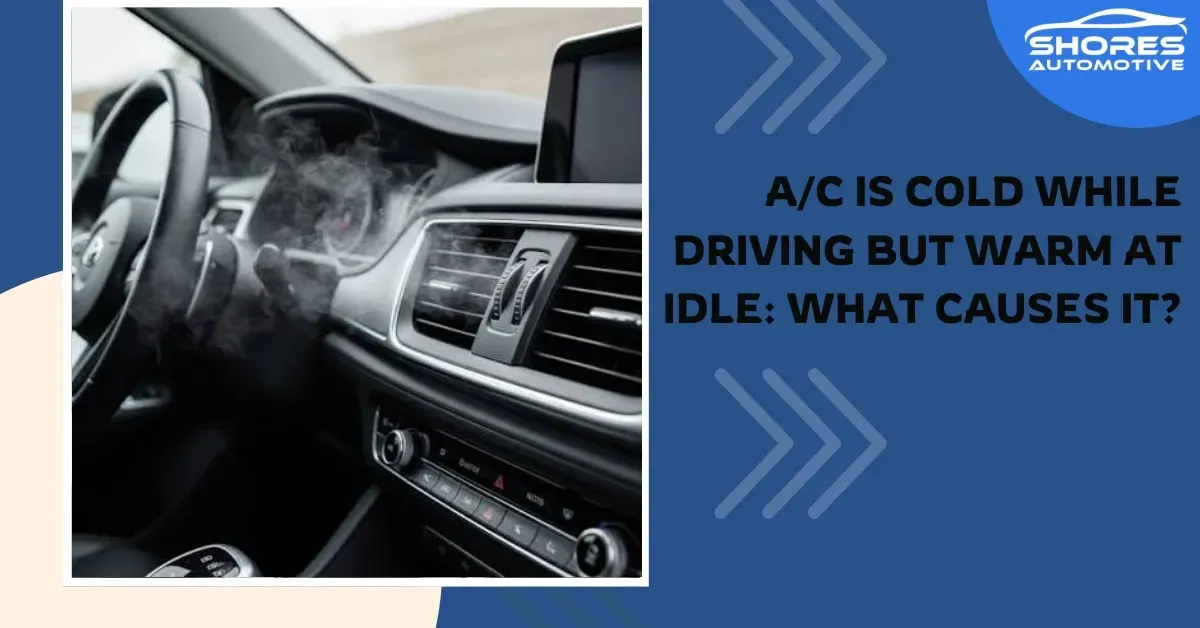
Why Does the A/C Get Warm When the Car Stops?
When the vehicle stops, less air moves across the condenser, making it harder for the A/C system to release heat. The evaporator absorbs cabin heat, and the condenser releases that heat at the front of the vehicle. Without enough airflow, cooling performance can drop while the car is sitting in traffic.
Road Speed Can Hide a Condenser Airflow Problem
While the vehicle is moving, outside air passes through the grille and across the condenser. That airflow may be enough to keep the refrigerant condensing and the vent temperature low, even when a cooling fan is weak or not operating correctly.
At idle, the fans must provide nearly all of that airflow. If the A/C becomes cold again soon after the vehicle starts moving, condenser fan operation and front-end airflow should be checked early in the diagnostic process.
The Exact Symptom Helps Narrow the Test Plan
A technician needs to know whether the air becomes slightly warmer or completely hot, how long the change takes, and whether the blower volume stays strong. It also matters whether the issue appears only after a long drive, during stop-and-go traffic, or whenever the engine returns to idle.
Record any temperature-gauge movement, warning messages, fan noise, compressor noise, or change in engine speed. These details help separate an A/C-only concern from an engine cooling, electrical, or accessory-drive problem.
Weak Cooling Fans and Restricted Condenser Airflow
A weak cooling fan is one of the most common reasons an A/C system loses cooling at idle. Modern European vehicles may use several fan speeds, electronic fan modules, pulse-width control, or a combined radiator and condenser fan assembly. A fan can still turn while failing to move enough air under a high heat load.
Fan Motors, Control Modules, Relays, and Wiring Can Fail
A fan concern may come from the motor, control module, fuse, relay, wiring, connector, temperature input, or command signal. Some faults store a code in the engine or climate-control module, while others appear only when the system is hot or the fan is commanded to a higher speed.
The fan should be evaluated under the conditions that reproduce the complaint. Simply seeing it spin in the service bay does not prove that it reaches the correct speed or responds to A/C pressure and engine temperature as designed.
Debris and Damaged Fins Can Reduce Heat Transfer
Leaves, road debris, insects, plastic bags, or heavy dirt can restrict airflow through the condenser. Bent fins, corrosion, or damage from a front-end impact can also reduce the surface area available for heat transfer.
Many vehicles stack the condenser, radiator, charge-air cooler, and other heat exchangers close together. The visible front surface may look clear while debris remains trapped between components, so inspection may require access beyond a quick look through the grille.
Low Refrigerant, Leaks, and Incorrect System Charge
When the refrigerant level or system charge is not correct, A/C performance can become inconsistent, especially at idle and in high outside temperatures. The remaining refrigerant may produce some cooling at speed, but the system has less capacity to absorb cabin heat and maintain stable pressures in traffic.
Refrigerant Loss Should Lead to Leak Testing
Automotive A/C refrigerant circulates in a closed system. When the charge is low, the service should include an inspection for leakage rather than repeated top-offs. Common leak areas include service ports, hose connections, seals, the condenser, compressor, evaporator, and pressure sensors.
Leak detection may involve an electronic detector, ultraviolet dye when appropriate, visual inspection, or other vehicle-specific testing. The leak location and repair scope should be confirmed before major parts are recommended.
Overcharging Can Also Cause Warm Air at Idle
Adding refrigerant without measuring the existing charge can overfill the system. An overcharged system may develop excessive high-side pressure, cycle incorrectly, or reduce cooling when condenser airflow is limited.
The required refrigerant type and weight are vehicle-specific. R-134a and R-1234yf require different service equipment and must not be mixed. Professional service recovers the existing refrigerant, checks the system, evacuates it when required, and installs the specified amount by weight.
Compressor and Control Problems Can Appear at Idle
Problems with output or electronic control can reduce A/C cooling most noticeably when the engine is running at low speed. A worn compressor, sticking control valve, or clutch problem on an equipped vehicle may still allow acceptable cooling at higher speeds. A pressure-sensor fault or electronic command problem can also reduce refrigerant flow enough to affect cooling when the vehicle is stopped.
European Vehicles Use Different Compressor Designs
Many European vehicles use variable-displacement compressors that adjust output instead of cycling a traditional clutch on and off. Hybrids and electric vehicles may use high-voltage electric compressors. The correct test therefore depends on the vehicle's design and cannot be reduced to listening for a clutch click.
A scan tool may be needed to compare requested compressor output, control-valve command, pressure-sensor data, evaporator temperature, and module faults. Mechanical pressure and temperature measurements provide another part of the diagnosis.
Belts and Tensioners Can Affect Belt-Driven Compressors
On vehicles with a belt-driven compressor, a worn belt, weak tensioner, damaged pulley, or accessory-drive problem can reduce compressor speed or create noise under load. These concerns may be more noticeable at idle because the belt is moving more slowly.
Squealing, rattling, a burning-rubber smell, visible belt damage, or simultaneous charging and engine-temperature warnings require prompt attention. A failed accessory belt can affect more than cabin cooling.
Other Climate-Control Problems Can Feel Similar
Not every warm-air complaint is caused by refrigerant or the compressor. Cabin airflow, temperature doors, sensors, valves, and automatic climate-control settings can change what reaches the vents even when the refrigeration circuit is operating.
Weak Airflow Is Different From Warm Air
A clogged cabin filter, failing blower motor, blower-control module, or restricted duct can reduce the amount of air coming from the vents. These problems usually affect airflow at more than one driving speed and may be more noticeable on higher fan settings.
If the blower remains strong but the air temperature rises only when the vehicle stops, the cabin filter is less likely to be the main issue. Condenser airflow, refrigerant pressures, and compressor operation may deserve more attention.
Blend Doors, Heater Valves, and Sensors Can Change Vent Temperature
A sticking blend door, actuator fault, heater-control valve problem, evaporator-temperature sensor, sunlight sensor, or climate-control module issue can produce inconsistent vent temperatures. Dual-zone systems may blow different temperatures from the left and right vents when an actuator or control problem develops.
A diagnostic scan of the climate-control module, actuator tests, temperature measurements, and inspection of coolant flow can help separate an air-mixing problem from a refrigerant concern.
Engine Cooling Problems May Appear at the Same Time
The condenser and radiator often share the same fans and front-end airflow. A failed fan can therefore cause weak A/C cooling at idle and allow engine temperature to rise in traffic. This combination requires more urgent attention than an isolated comfort concern.
Watch the Temperature Gauge and Warning Messages
Stop driving when the engine temperature rises into the warning range, an overheating message appears, steam is visible, coolant is leaking, or a strong coolant smell develops. Turn off the engine in a safe location and arrange assistance according to the owner's manual.
Do not open a hot cooling system. Pressurized coolant can cause severe burns. An A/C complaint accompanied by overheating needs cooling-system and fan testing before the vehicle returns to normal traffic.
A/C Loss Alone Is Usually Not an Immediate Driving Emergency
If the engine temperature stays normal, loss of cabin cooling alone may not require an immediate roadside stop. This generally applies when there are no warning lights, unusual noises, burning smells, or belt concerns. The system should still be inspected soon because pressure problems, fan faults, or compressor wear can become more expensive if ignored.
How Professional Cooling and A/C Diagnostics Find the Cause
Cooling and A/C diagnostics in Boca Raton, FL, should reproduce the concern and measure system behavior at idle. Testing at a controlled higher engine speed can help pinpoint the problem. Diagnosis should not begin with an automatic refrigerant recharge.
Testing Should Include Airflow, Temperature, Pressure, and Electronic Data
Depending on the vehicle, testing may involve vent-temperature readings, condenser and radiator fan commands, and refrigerant pressure and temperature measurements. Other checks may cover visual inspection, leak detection, blower operation, compressor control data, and climate-control module scans.
The technician may also evaluate the engine cooling system, accessory belt, condenser cleanliness, refrigerant identification, and exact charge when the initial findings point in those directions. The repair recommendation should match confirmed results.
Avoid Clearing Faults Before the Appointment
Do not disconnect the battery, erase climate-control codes, or add refrigerant before diagnosis unless a qualified technician directs you to do so. Stored faults, pressure history, and the original symptom can provide useful clues.
Note the outside temperature, vehicle speed, fan setting, selected cabin temperature, and how long the A/C takes to become warm. A short video of the display or warning message may also help document an intermittent concern.
Schedule European A/C Repair in Boca Raton, FL
If your A/C cools on the highway but warms in traffic, professional testing can determine whether refrigerant, fan controls, compressor, or climate electronics are involved. Shores Automotive provides European A/C repair in Boca Raton, FL, including leak detection, refrigerant service, compressor and condenser evaluation, airflow checks, and dealer-level diagnostic support.
The shop is located at 2544 NW 2nd Avenue, Boca Raton, FL 33431. Qualifying repairs include a 3-year/36,000-mile nationwide warranty. Contact Shores Automotive to schedule an inspection and determine why the cooling changes at idle.Frequently Asked Questions
Can a dirty cabin filter make the A/C warm at idle?
A dirty cabin filter can reduce airflow, but it usually does not cause A/C air to turn warm only at idle. If the blower volume remains strong while the air warms when the vehicle stops, another A/C or airflow issue may be involved. The filter should still be inspected if airflow is weak at several speeds.
Does low refrigerant always mean the system has a leak?
Low refrigerant generally means refrigerant has escaped from the system. The amount and source of loss can vary, so leak testing and an exact charge measurement are needed before deciding whether a recharge alone is appropriate.
Can I use a recharge can to fix the problem?
Using a recharge can may add refrigerant, but it cannot properly diagnose or fix the underlying A/C problem. It cannot confirm the refrigerant type, existing charge, high-side pressure, leak source, or fan operation. Adding too much refrigerant or mixing products can create new problems. A/C refrigerant should be handled with the proper recovery and charging equipment.
Why does the A/C improve when I raise the engine speed?
Raising the engine speed can improve A/C cooling by increasing output from a belt-driven compressor and changing fan operation. The improvement may be temporary if the system has low refrigerant, weak compressor control, or poor condenser airflow. It does not identify which fault is causing the problem.
How often does a European car need an A/C recharge?
A/C refrigerant does not normally need a fixed annual recharge. Service is appropriate when performance changes, testing confirms an incorrect charge, or a repair requires the system to be opened. Follow the vehicle manufacturer's maintenance guidance for filters and related checks.
Restore Consistent Cooling Before the Next Traffic Jam
A European car A/C system that is cold while driving but warm at idle may have a fan, condenser, refrigerant, compressor-control, airflow, or engine cooling problem. The symptom provides a useful clue, but measurements are needed before parts are selected.
Schedule auto A/C repair with Shores Automotive in Boca Raton, FL, to identify the cause and restore consistent cooling in traffic.
A car A/C system that blows cold while driving but turns warm at idle often has a condenser airflow problem. Road speed pushes air across the condenser, but a stopped vehicle depends on electric cooling fans to remove heat. Low refrigerant, an incorrect charge, compressor-control faults, or other climate-control problems can create the same pattern.
The symptom should be tested instead of treated with a quick recharge. The right diagnosis depends on vent temperature, fan operation, refrigerant pressures, compressor command, outside temperature, and whether the engine cooling system also becomes hot in traffic.
Key Takeaways
- Cold air at road speed but warm air at idle commonly points to weak condenser airflow or a cooling-fan fault.
- Low refrigerant can reduce cooling, but refrigerant loss usually means the system needs leak testing before it is recharged.
- Too much refrigerant, air in the system, or an incorrect refrigerant type can also cause poor cooling and high pressure.
- A strong blower with warm vent air is different from weak airflow caused by a cabin filter, blower motor, or duct problem.
- Cooling and A/C diagnostics should confirm the failed system before a compressor, fan, sensor, or other part is replaced.
Get started today
Mon – Fri | 7:30am – 4:00pm
Sat – Sun | Closed