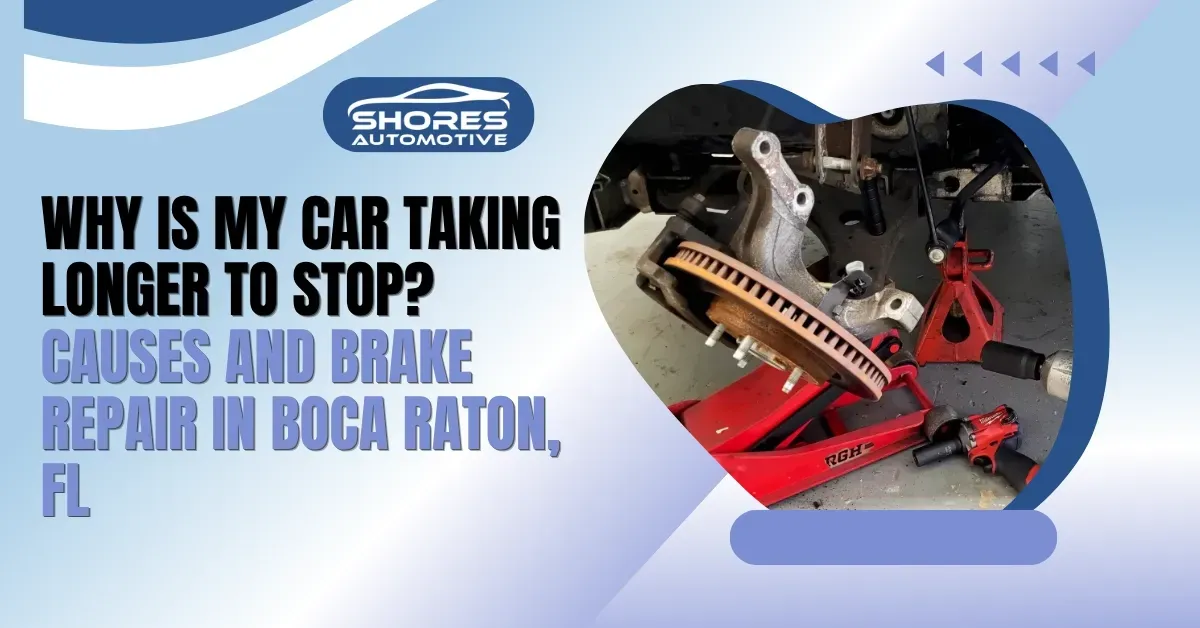
If your car is taking longer to stop, do not ignore it. You may notice the brake pedal feels different, the vehicle needs more distance to slow down, or you are pressing harder than usual. These small changes can point to brake wear or another issue that needs attention before it affects your safety.
That shift in how your car stops is rarely nothing. For European and exotic vehicle owners, it deserves attention well before South Florida traffic turns a small concern into a serious one.
If you have been asking yourself why your car is slow to stop, the answer is almost always mechanical and almost always fixable. Getting it right starts with understanding the braking system as a whole rather than checking one component and moving on. Brake repair in Boca Raton, FL, is most effective when it begins with a real diagnosis, not a guess.
When Stopping Takes More Effort Than It Should
Brake problems do not always arrive with a grinding noise or a dashboard light. On many European vehicles, the drop in braking performance is gradual enough that drivers quietly adapt without noticing what has changed.
The Difference Between a Gradual Change and a Sudden One
A sudden change, such as a spongy pedal out of nowhere or a grinding sound that appeared overnight, usually points to an acute failure somewhere in the system. That needs immediate attention.
A gradual change is quieter but just as meaningful. You may notice over weeks or months that your stopping distance has increased. The brake pedal may also need more travel before the car responds. Wet-road braking can feel less confident, too. When these changes appear gradually, the brake system may have been wearing down in the background. Neither situation gets better with time.
Why European and Exotic Vehicles Respond Differently
A BMW, Porsche, or Range Rover is not engineered with generic braking in mind. These vehicles are built around specific rotor sizes, pad compounds, caliper designs, and fluid specifications that function as a coordinated system. When one component falls out of spec, even slightly, the effect on stopping performance is more noticeable than it would be on a lower-performance vehicle.
Diagnosis matters here. European brake service in Boca Raton should begin with understanding what the system is supposed to feel like before measuring what is visibly worn.
Common Reasons Your Car Is Slow to Stop
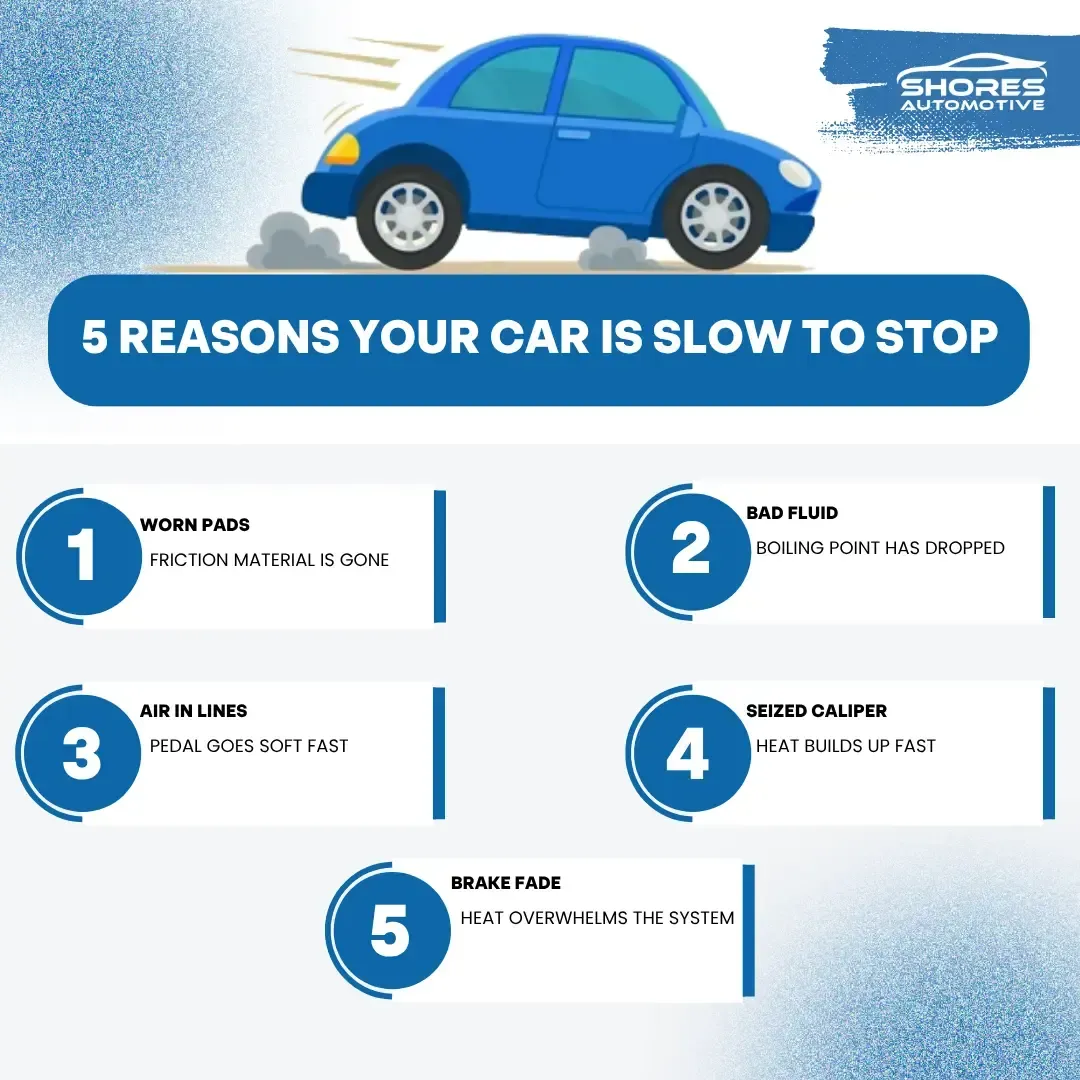
Several mechanical conditions can explain why your car takes longer to stop. Some are straightforward. Others require a closer look to identify correctly.
Worn Brake Pads and Rotors
This is the most common cause. As brake pads wear down, the friction material thins and the system loses its ability to convert speed into heat efficiently. Rotors that have worn unevenly, developed grooves, or warped from repeated heavy use make the situation worse.
On performance-oriented vehicles like a Porsche 911 or a BMW M car, rotor condition has a direct and noticeable effect on pedal feel and stopping confidence.
Rotors that have gone beyond their minimum thickness specification cannot be corrected by resurfacing. Replacement is the only path forward, and using OEM-quality components matters when the vehicle was designed around a specific rotor mass and friction pairing.
Brake Fluid Issues
Brake fluid absorbs moisture over time. As moisture content rises, the fluid's boiling point drops. Under hard braking or sustained downhill braking, degraded fluid can begin to vaporize inside the lines. That vapor compresses in ways that fluid cannot, and the pedal starts to feel soft or inconsistent.
Most European manufacturers specify brake fluid changes at fixed intervals for exactly this reason. Before assuming the problem lies elsewhere, check your fluid's condition if it has not been replaced in a few years.
Air in the Brake Lines
Air in the hydraulic lines produces the same symptom as degraded fluid: a pedal that feels spongy or requires more travel than normal. Air can enter the system through a leak, an improperly completed service, or after brake component replacement. A proper bleed procedure removes it, but the source of the air entry still needs to be found.
Brake Caliper Problems
Calipers that are sticking or not releasing fully can create uneven braking behavior, pulling to one side under braking, or accelerated wear on pads and rotors.
On some vehicles, a seized caliper creates enough drag that the rotor overheats during routine driving, leading to brake fade even without aggressive use. The caliper's behavior needs to be tested and confirmed before parts are ordered.
Brake Fade From Heat
Brake fade happens when the braking system generates more heat than it can shed. The result is a pedal that responds less under sustained use. For drivers navigating heavy traffic on I-95, Glades Road, or Palmetto Park Road, fade from repeated hard stops can be a real factor. This is especially true when pad compound, rotor condition, or fluid quality is already compromised going into a long drive.
How Boca Raton Driving Conditions Factor In
South Florida driving puts a particular kind of stress on brake systems. The heat here is not limited to summer. Ambient temperatures stay elevated for most of the year, which means braking components run warmer during normal daily driving than they would in a cooler climate.
Stop-and-go traffic along Federal Highway and Glades Road creates repeated load cycles that wear pads faster than highway driving alone. Coastal moisture near A1A and through communities along the Intracoastal contributes to corrosion on rotors and caliper hardware, particularly on vehicles that sit for extended periods. That applies to numerous cars brought south for snowbird season.
Vehicles arriving from the Northeast or Midwest in the fall often come with brake systems that have seen salted roads, cold-weather braking stress, and deferred service. A brake inspection Boca Raton drivers schedule at the start of the season often turns up more than expected. That is not a sales pitch. It is just the reality of what a car goes through on the drive down.
What Happens If You Ignore Longer Stopping Distances
Increased stopping distance is not a stable condition. It tends to progress.
- Worn pads become metal-on-metal contact
- Warped rotors develop cracks
- Fluid that should have been replaced two years ago becomes a liability under hard braking
The cost difference between catching a brake issue as soon as possible and addressing it after the system has been further damaged is significant. More practically, stopping distance directly affects your ability to avoid a collision. In Boca Raton traffic, that margin is not abstract.
European Brake Service in Boca Raton: What a Proper Inspection Covers
A proper brake evaluation on a European or exotic vehicle is not a quick visual check followed by a price quote. It is a systematic review of every component that affects stopping performance.
Inspecting the Full System, Not Just the Pads
At Shores Automotive, a brake inspection includes checking pad thickness and wear patterns. We also inspect the rotors, measure their condition, and evaluate caliper function. Our team reviews the brake lines, hardware, and fluid condition as well. We also check for stored codes or warning signals from the vehicle’s brake management system.
On vehicles with electronic parking brakes or more integrated brake control systems, the diagnostic process includes software-side checks alongside the physical inspection.
The goal is understanding why stopping performance has changed. Not simply identifying the most obvious worn part.
OEM Parts and Correct Spec Fluids
Replacing brake components on a Porsche Cayenne, a Mercedes GLE, or a Land Rover Defender with off-spec parts creates a new set of problems. Pedal feel, rotor longevity, and braking balance all depend on components matched to how the vehicle was built.
Shores uses OEM-quality parts and spec-correct brake fluid so the repair restores the system to factory behavior, not just to good-enough.
Fluid selection matters just as much. European manufacturers frequently specify DOT 4 or DOT 5.1 fluids with higher boiling points than standard domestic specifications. Using the right fluid is not a detail. It is part of the repair.
Takeaways
Longer stopping distances are one of the clearest signals a vehicle sends before a brake problem reaches a critical point. On European and exotic vehicles, braking systems are often built with tighter tolerances and specific component requirements. That means small issues can become expensive faster than many owners expect. Early diagnosis is important because the gap between a minor brake service and a larger repair bill can be much smaller on these vehicles.
Paying attention to how the pedal feels and how the car responds under normal braking is not being overly cautious. It is basic ownership awareness for vehicles that deserve that level of attention.
Brake repair in Boca Raton at a shop that understands European and exotic vehicles means inspecting the full system. It uses correct parts, and explains what was found before any work begins. That is the standard every service at Shores Automotive is committed to.
Frequently Asked Questions About Brake Problems
Why does my car take longer to stop but the brake light is not on?
Many brake problems develop before they trigger a dashboard warning. Wear indicators and pressure sensors have thresholds, and stopping distance can increase noticeably before any of those thresholds are crossed. If your stopping feel has changed, a physical inspection will tell you more than waiting for a light to confirm it.
How do I know if it is brake fade or a mechanical problem?
Brake fade typically occurs under sustained or repeated hard braking and tends to recover once the system cools. A mechanical problem, such as worn pads, a soft pedal from fluid or air issues, or a sticking caliper, tends to be consistent regardless of temperature. If braking feels off even on routine stops, the cause might be mechanical. A diagnostic inspection will make that clear.
Can I drive my car if it is taking longer to stop?
It depends on how significant the change is. A subtle increase in stopping distance may allow for careful short-distance driving to a shop. A spongy pedal, pulling to one side under braking, or a noticeable increase in stopping distance are reasons to get the vehicle inspected before driving it further. When in doubt, call the shop first.
Do European vehicles need special brake pads?
Yes, most European vehicles need special brake pads. European performance and luxury vehicles are designed around specific pad friction coefficients, rotor materials, and thermal profiles. A generic replacement pad may physically fit the caliper but can alter pedal feel, increase rotor wear, and reduce overall braking performance. OEM or OEM-equivalent pads matched to the vehicle's specification are the correct starting point.
How often should brake fluid be replaced on a European car?
Most European manufacturers recommend brake fluid replacement every two years regardless of mileage. Some performance-focused vehicles call for it annually. Fluid condition can be checked during any brake inspection and should be a standard part of routine European service.
Schedule Your Brake Inspection at Shores Automotive in Boca Raton
Shores Automotive specializes in European and exotic vehicles, including BMW, Porsche, Mercedes-Benz, Land Rover, Audi, Maserati, Jaguar, and more. A brake inspection here covers the full system, not just the parts that are easy to see.
If you notice your car takes longer to stop than it used to, have a mechanic inspect it. Someone who understands how these vehicles are built and what they need to perform correctly.
For drivers coming from Delray Beach, Lighthouse Point, Highland Beach, or anywhere along the Boca corridor, loaner cars, valet pickup and drop-off, early drop-off, and after-hours pickup are all available so the visit fits your schedule.
Schedule service online for transparent pricing, OEM-quality parts, and a 3-year warranty on qualifying work are part of every repair.
Get started today
Mon – Fri | 7:30am – 4:00pm
Sat – Sun | Closed