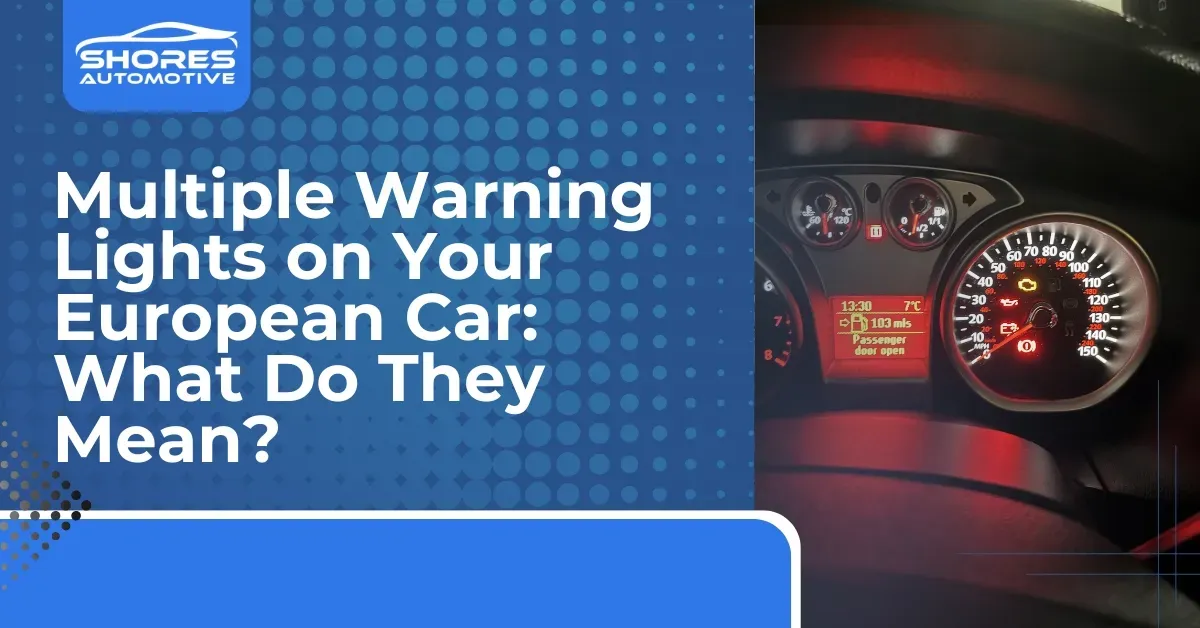
Multiple warning lights on a European car can come from one shared fault or several separate problems. A weak battery, charging-system failure, wheel-speed sensor fault, overheating condition, low oil pressure, or communication problem between control modules may activate several alerts at once.
The color of the lights, the way the vehicle feels, and the conditions present when the warnings appeared help determine the next step. Red or flashing warnings may require an immediate stop, while yellow warnings usually call for prompt diagnosis before the fault causes additional problems.
Key Takeaways
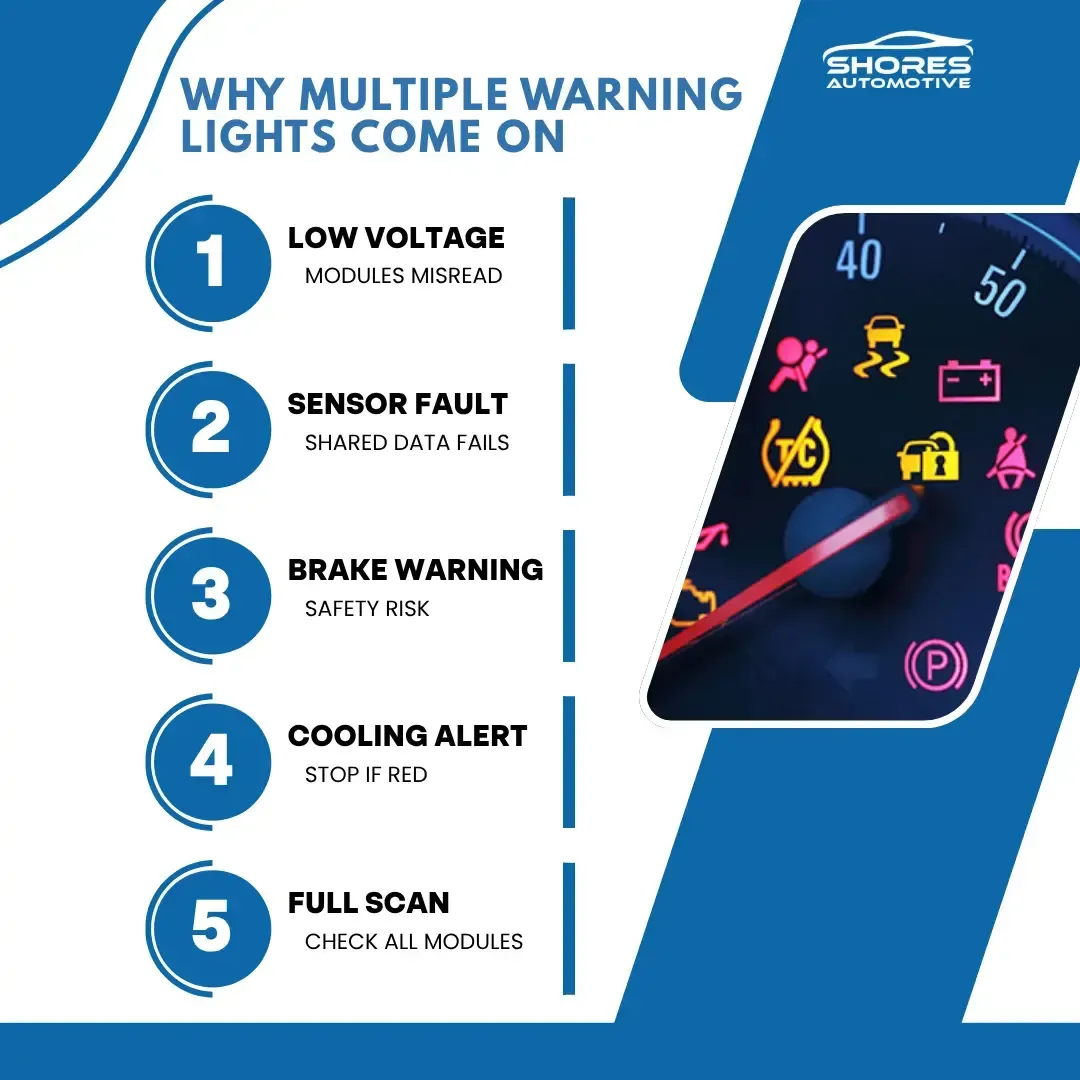
- One electrical, sensor, or communication fault can trigger warnings in several connected vehicle systems.
- A weak battery or charging problem can create multiple alerts because European control modules depend on stable voltage.
- Red oil-pressure, overheating, brake, or steering warnings may require the driver to stop and shut the vehicle off.
- A generic code reader may miss manufacturer-specific faults stored in the brake, body, transmission, steering, or network modules.
- Photograph the dashboard and record the driving conditions before the codes are cleared or the battery is disconnected.
Why Several Dashboard Warning Lights Can Appear Together
European vehicles use connected control modules to manage the engine, transmission, brakes, steering, stability control, suspension, and body electronics. A fault in one system can affect the information used by several others.
One Fault Can Affect Several Connected Systems
A failed wheel-speed sensor may affect the anti-lock brake system, traction control, stability control, and driver-assistance features because those systems use the same wheel-speed data. A low-voltage event can create communication faults across several modules even when the modules themselves are not defective.
Multiple lights do not always have one cause. An older vehicle may have a battery concern and a separate brake or engine fault simultaneously. Diagnosis should test each warning in context instead of assuming that replacing one part will clear every alert.
Know the Difference Between a Bulb Check and a Stored Warning
Many dashboard lights illuminate briefly when the ignition is switched on. This self-check is normal when the lights go out after the engine starts.
A light that stays on, returns while driving, flashes, or appears with a fault message needs attention. Check the owner’s manual for the exact symbol and instructions because colors and messages can vary by manufacturer and model.
Common Warning Light Combinations and Possible Causes
The combination of warning lights can narrow the diagnostic direction, but it cannot confirm a failed part by itself. The following patterns are common starting points for testing.
Battery, ABS, Traction Control, and Steering Warnings
Several unrelated-looking warnings may appear when system voltage drops below the level required by the control modules. Possible causes include a discharged or failing battery, alternator output problems, loose battery connections, poor grounds, or excessive resistance in a charging cable.
Some European vehicles also require battery registration or coding after replacement. The correct procedure depends on the make, model, battery type, and vehicle configuration. A battery should be tested with the charging system rather than replaced based only on dashboard lights.
Check Engine, Drivetrain, Transmission, or EPC Warnings
These warnings may appear together when an engine-management problem affects torque delivery or transmission operation. Misfires, throttle-control faults, fuel-pressure problems, airflow-sensor issues, boost-control faults, and module communication errors are possible causes.
The vehicle may enter a reduced-power or limp mode to limit load on the affected system. Avoid heavy acceleration. A flashing check engine light, strong shaking, fuel odor, or major loss of power can indicate an active misfire or another condition that should not be driven.
Brake, ABS, and Stability Control Warnings
A yellow ABS or stability warning may indicate that an electronic aid is unavailable. Base braking may still operate, but stopping behavior can change on wet or slippery roads. A red brake warning, low brake-fluid message, soft pedal, grinding, pulling, or reduced braking response requires immediate attention.
Learn more about brake repair and safety inspection when a warning appears with a change in pedal feel or stopping performance.
Coolant Temperature, Oil Pressure, and Red Master Warnings
A red coolant-temperature warning may indicate overheating, low coolant, a circulation problem, or a failed sensor. A red oil-pressure warning can imply that the engine is not receiving adequate lubrication. Both conditions can damage the engine quickly.
Move to a safe location and shut the engine off when the vehicle is overheating, oil pressure is low, or the manual directs you to stop. Do not open a hot cooling system. Arrange towing when restarting or driving could cause damage.
Is It Safe to Keep Driving With Multiple Warning Lights On?
Driving safety depends on the warning color, vehicle behavior, and the affected system. Do not continue simply because the engine still runs.
Stop Driving When a Critical System Is Affected
- Stop for a red oil-pressure or overheating warning and shut the engine off in a safe location.
- Do not drive with a soft brake pedal, major fluid leak, severe steering difficulty, smoke, or a burning odor.
- Treat a flashing check engine light with shaking or major power loss as an urgent condition.
- Pull over if the battery or charging warning appears with dim lights, electrical failures, or signs that the engine may stall.
- Use the owner’s manual and roadside assistance when the correct action is unclear. Towing is usually less costly than engine, transmission, brake, or electrical damage caused by continued driving.
Schedule Prompt Diagnosis Even When the Car Feels Normal
Some faults do not change the way the vehicle feels right away. A stored sensor, emissions, ABS, charging, or network fault may still disable a safety feature, increase emissions, drain the battery, or become intermittent.
Limit unnecessary driving and schedule warning light diagnosis in Boca Raton, FL, when several lights remain on. Early testing preserves fault data and may prevent a minor electrical or sensor problem from becoming a no-start or breakdown.
Why European Auto Diagnostics Should Go Beyond Code Reading
A fault code identifies the system that detected a problem. It does not automatically identify the failed component or prove that a part needs replacement.
Generic Scanners May Not Reach Every Control Module
Basic OBD-II readers commonly focus on emissions-related powertrain codes. European vehicles may also store useful information in the ABS, airbag, steering, transmission, body, suspension, gateway, and driver-assistance modules.
A dealer-level scan for European vehicle warning lights can provide manufacturer-specific fault descriptions, live values, freeze-frame data, and network status. It may also reveal module histories that a basic code reader cannot display.
Testing Must Confirm the Cause Before Parts Are Replaced
A complete diagnostic process may begin with battery and charging-system tests, followed by a full-vehicle scan and visual inspection. Technicians may also check power and grounds, sensor plausibility, live data, and wiring. When the vehicle is safe to operate, the process may include a road test.
Low-voltage or communication codes may be secondary results rather than the original problem. Technicians should compare code timing, system voltage, service history, and current symptoms before recommending repairs.
What to Do Before Your Diagnostic Appointment
Accurate details from the driver can help reproduce an intermittent concern and shorten the diagnostic path. Record what happened before the lights disappeared or the vehicle was restarted.
Photograph the Dashboard and Record the Conditions
- Photograph every warning light and message while the vehicle is safely parked.
- Note whether the warnings appeared at startup, while idling, during acceleration, after rain, or after a long drive.
- Record any rough running, slow cranking, steering change, braking change, odor, noise, leak, or loss of power.
- List recent battery work, jump-starts, repairs, accessory installations, water intrusion, or collision damage.
- Bring the vehicle’s service history and the approximate date, mileage, and outside temperature when the fault occurred.
Do Not Erase Useful Fault Information
Do not disconnect the battery or clear codes only to turn the lights off. This may remove freeze-frame data, reset readiness monitors, create relearn requirements, or make an intermittent fault harder to reproduce.
A warning may go away temporarily after a restart even though the underlying fault remains. Share the photos and symptoms with the technician so the diagnosis is not based only on what is active at the moment of inspection.
How South Florida Conditions Can Contribute to Warning Lights
Boca Raton heat and humidity can add stress to batteries, charging systems, connectors, cooling components, and electronics. These conditions do not identify the cause, but they can influence when an existing weakness becomes noticeable.
Heat Can Expose Battery and Charging Weakness
High underhood temperatures can accelerate battery aging and increase the electrical load from air conditioning and cooling fans. A marginal battery or charging connection may cause slow cranking, repeated low-voltage codes, or several warning lights after startup.
Shores Automotive provides electrical system diagnostics and repair for battery, charging, starting, wiring, module, and warning-light concerns.
Moisture and Corrosion Can Cause Intermittent Faults
Humidity, water intrusion, and corrosion at connectors or ground points can create faults that appear only after rain, washing, temperature changes, or extended parking. Intermittent problems may require wiring inspection and testing while the symptom is present.
Tell the technician if the warnings follow a weather pattern. This detail can help direct testing toward seals, drains, connectors, harnesses, grounds, or modules that may be affected by moisture.
Schedule European Warning Light Diagnosis in Boca Raton, FL
Shores Automotive uses dealer-level diagnostic software for European and exotic vehicles. Supported brands include BMW, Mercedes-Benz, Porsche, Audi, Land Rover, Jaguar, MINI, Maserati, Bentley, Rolls-Royce, Alfa Romeo, and Aston Martin. Its diagnostic process is designed to evaluate module faults, live data, electrical concerns, and drivability symptoms before repairs are recommended.
The shop is located at 2544 NW 2nd Ave in Boca Raton, FL. OEM parts are standard, and qualifying repairs carry a 3-year/36,000-mile nationwide warranty. Loaner cars and valet pickup are available to help customers manage longer diagnostic or repair appointments.
Schedule European service with Shores Automotive or call (561) 391-0260 if several warning lights remain on or return after being cleared. Service is also recommended when warning lights appear alongside a change in vehicle performance.
Frequently Asked Questions
Can a weak battery cause multiple warning lights on a European car?
Yes, a weak battery can cause multiple warning lights on a European car. Low or unstable voltage can cause several control modules to store faults or stop communicating correctly. The battery, alternator, cables, grounds, and charging voltage should be tested before assuming that every illuminated system has failed.
Should I disconnect the battery to reset the warning lights?
No, you should not disconnect the battery to reset the warning lights. Disconnecting the battery may erase useful diagnostic information and can create clock, window, steering, transmission, or battery-management relearn requirements. Diagnose the cause before clearing codes or removing power.
What does it indicate if the ABS and traction control lights come on together?
The two systems share information, so one wheel-speed sensor, wiring, voltage, module, or communication fault can affect both. Electronic braking aids may be limited even when the normal brake pedal still feels firm, so the vehicle should be inspected promptly.
Why did the warning lights appear after a battery replacement?
Warning lights may appear after a battery replacement for several reasons. The vehicle may have stored low-voltage faults, loose connections, or an incorrectly specified battery. Some battery-management systems may also require registration or coding. The correct procedure varies by vehicle, so the charging system and installation should be checked.
Can a warning light turn off even if the problem is still present?
Yes, a warning light can turn off even if the problem is still present. An intermittent fault may stop meeting the conditions needed to illuminate the light, but the module may retain a history code or freeze-frame record. A full scan can help identify faults that are not active during the appointment.
Conclusion
Multiple warning lights on a European car should be treated as diagnostic clues, not as a list of parts to replace. One weak battery, sensor, wiring fault, overheating condition, brake concern, or module communication problem may affect several systems at once. Stop driving for red or flashing warnings, major braking or steering changes, overheating, low oil pressure, smoke, or severe running problems. When the vehicle still feels normal, arrange prompt European auto diagnostics in Boca Raton, FL, before the fault returns or disables another system.
Get started today
Mon – Fri | 7:30am – 4:00pm
Sat – Sun | Closed